In short
- What happened: either Windows doesn't know the video's compression type (a codec, usually the HEVC of newer cameras and phones), or the file itself is damaged, almost always because the recording was cut off.
- What not to do right now: don't convert, don't rename the extension, and don't install “codec packs” from random sites.
- What to do: open another clip from the same camera. If that one won't open either, it's the codec, and the fix is free and takes a minute. If only this file won't open, it's broken: go to the steps below.
- Don't want to deal with it? Send me the file. The check is free, and if I couldn't recover it, you get your money back. How to send it.
The 30-second test
Open another clip from the same camera, shot the same day with the same settings.
- That one won't open either? It's the codec, not the file. Nothing is broken. The fix is in the next section.
- The other clips open fine, and only this one doesn't? The file itself is the problem. Skip to “If the file is broken”.
If it's the codec
- Open the file in VLC, a free player that plays everything without add-ons.
- Or install “HEVC Video Extensions” from the Microsoft Store, and the Windows apps will play it too.
How you know it worked: the file opens, and so do the other clips.
If the file is broken: what to do, step by step
- Copy everything to the computer. The broken file, and while you're at it a healthy clip from the same card. From now on work only on the copies. The card stays aside.
- Prepare a “sample clip”. A healthy recording from the same camera at exactly the settings the broken file was shot with: same resolution (4K, say), same frames per second (25, 50 or 100), same recording quality. Simplest: a clip you shot the same day, just before or after the broken one, without changing settings in between. The clip you copied from the card usually fits. If there isn't one, put a card in the camera, lens cap on, and record 30 seconds.
- Run a free program called untrunc. It takes the map from the healthy clip and builds a new one for the broken file. Download it here (Windows. A normal program with buttons, nothing to type). On the page that opens, download untrunc_x64.zip, unzip it, and run untrunc-gui.exe (not untrunc.exe, which is the version without the window). Pick the sample clip, pick the broken file, and run. If the file that comes out won't open, run it once more, that happens. How you know it worked: a new MP4 appears, and it opens in a player.
- Check the whole file, not just the start. The length should match what you shot. Scrub to five or six points along the video, especially near the end. At each one stop, play a few seconds, and check the picture moves smoothly and the lips match the speech. If the picture jumps or the sound drifts: the sample clip doesn't match closely enough. Find a closer match and run again. Don't switch programs.
Why it happened
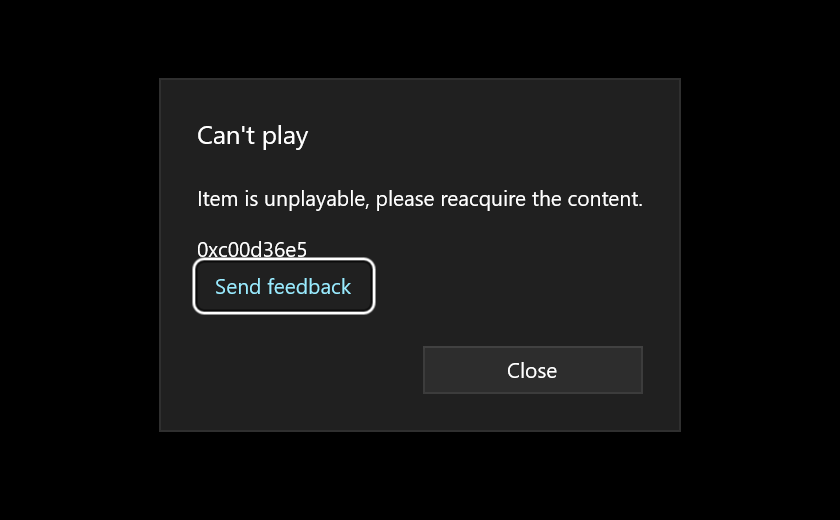
A recording that stopped early keeps its picture and sound but not the “map” that tells a player where each frame sits. Windows opens the file, finds no map, and shows a generic message. One more tell: on Windows 11 the Movies & TV app gave a cut-off recording a different code altogether, 0xc00d36e5 “Item is unplayable, please reacquire the content” (the dialog above). That message points at the file, not the codec.
On Sony cameras the broken file sometimes ends in .RSV instead of .MP4. That has its own page.
Short answers
- Does 0xc00d36c4 mean my video is corrupt? Usually not. Most of the time Windows just doesn't know the codec, typically HEVC. Test another clip from the same camera: if that won't open either, install the HEVC extension or use VLC.
- Will converting the file fix it? Only if some program can open it. If VLC can't either, the file has no map, and a converter can't read it. Rebuild the map first.
- VLC plays it but Windows doesn't? Then the file is fine. Install “HEVC Video Extensions” from the Microsoft Store, or keep using VLC.
- I got 0xc00d36e5 instead, “Item is unplayable”? That's the code a cut-off recording shows. Treat it as a broken file: copy it, get a sample clip, rebuild the map.
If you're stuck
If the file is big, if the second run also came out jittery, or you just don't have the head for this right now, send me a link to the file and to a healthy clip from the same camera. I first check whether the footage is actually in the file and tell you where you stand. That check is free. If there's something to recover and you want to go ahead, you get a price for the file. You pay, and then the work starts. And if I couldn't recover it, you get your money back, all of it or part of it, depending on the result.
Prefer email? avihaiteram@gmail.com
Who I am

Avihai Teram, videographer and video editor. I shoot on a Sony FX3 and work with camera files like these every day, so I know how a camera writes them and what breaks when it shuts off mid-recording, and I have brought files like these back from Sony and DJI cameras. Send me a file that won't open: the first check is always free, and if I couldn't recover it, you get your money back. You can also find me on Instagram: @avihai.teram.